


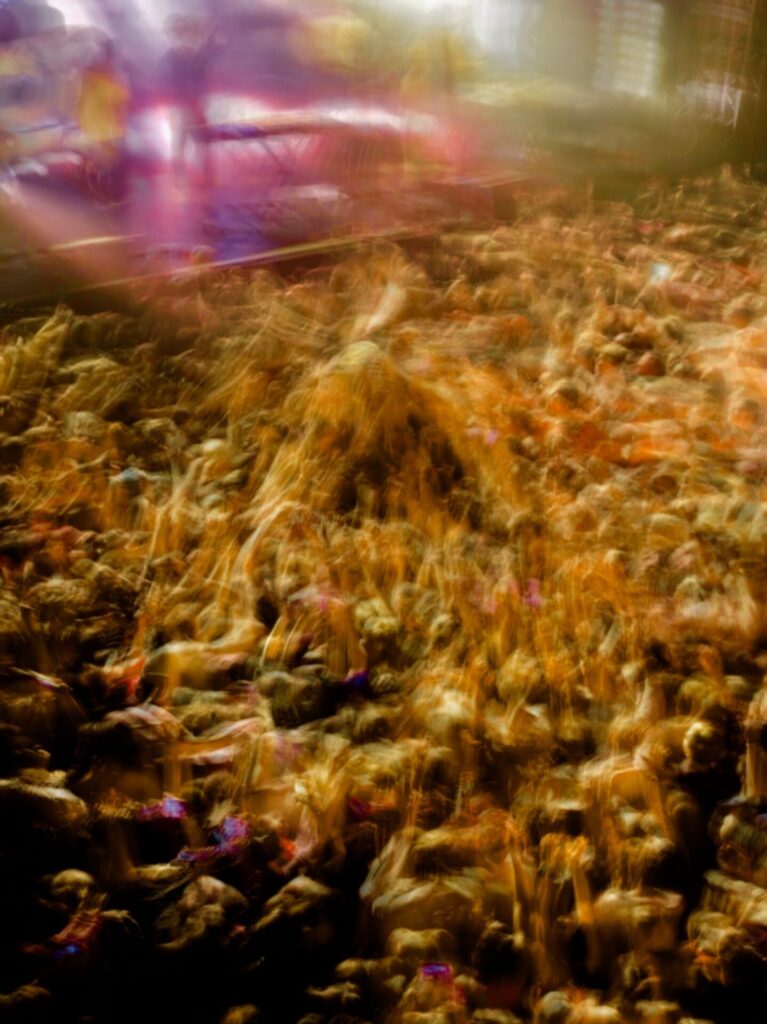

Through the voyeuristic lens of my phone camera, over the past two years I have been able to discreetly document every aspect of the spaces I find myself in. What began as a celebration – excited to explore what we had lost during lockdown – soon became a kind of social interrogation. Why has this environment begun to intrigue me so much? Why has my camera roll become filled with thousands of photographs and videos of countless faces, dissected by strobing lights? What is it about this environment that I am so intent on discovering?
At first, it was the people; a common theme of interest for social realist photographers like Nan Goldin and Wolfgang Tillmans – the darkened spaces and looser inhibitions provides a perfect alchemy. I have poured over the work of these artists, wanting to be in those spaces to meet those people unaffected by the surveillance state of the 21st century.
After a while, I began to switch my focus to interrogating the spaces themselves – perhaps they could satisfy my fixation. Their emptiness created a sense of loneliness, but filled with a crowd, the room would change immensely, appearing to be migrating and moving as one. The spotlight motif features heavily in my work, there is something ethereal and holy that is created from this artificial light source. The glows and colours seems akin to stained glass windows, and sometimes crowd scenes can appear almost biblical. In an age of constant information and lack of real connection, it appears to me that am trying to find that magic, that community. Trying to instil some wonder, some play into a confusing, self-aware world, overloaded with information.
Perhaps, I am just adding to the noise, preaching to the ever-saturated choir of drunk, blurry mobile phone photos taken after a night out. I never thought so.